AR
AR Saint Kitts and Nevis
 Dominica
 Grenada
 Antigua & Barbuda
 Saint Lucia
 Vanuatu
 Turkey
 Naoero
 Greece
 Portugal
 Latvia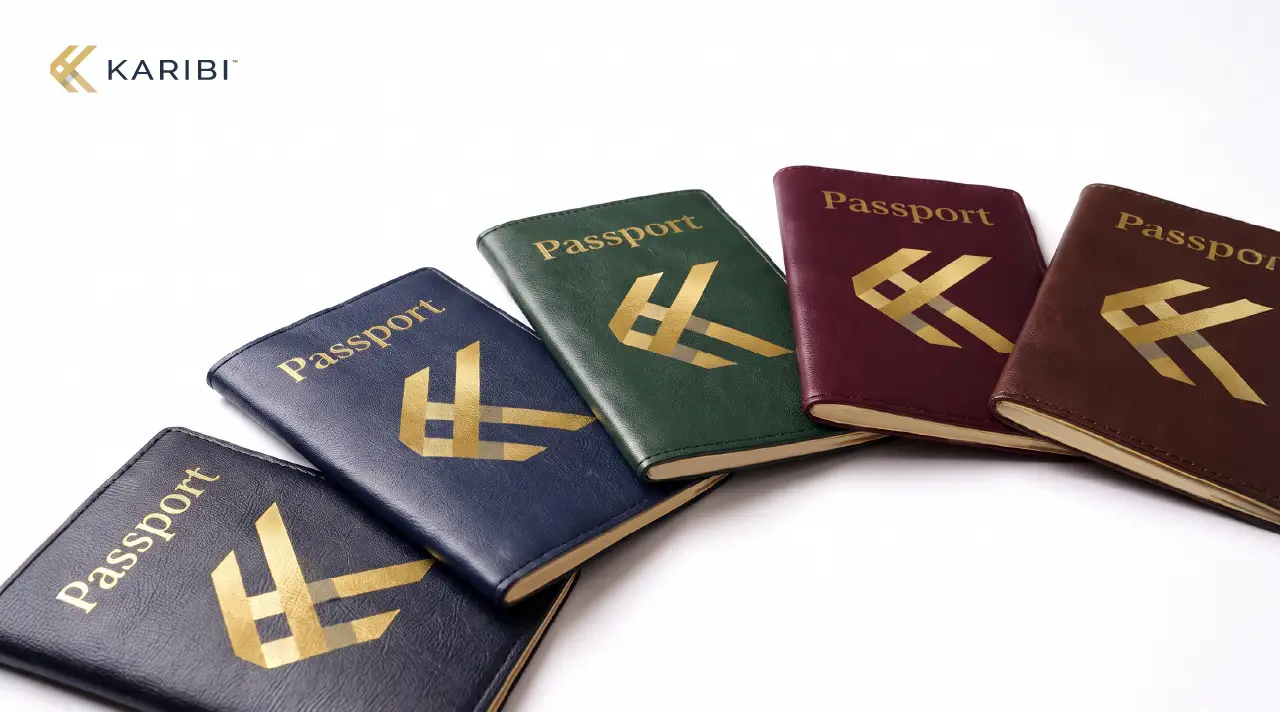
Stack every passport in the world on one table, and a pattern appears that nobody planned. Close to two hundred sovereign states, thousands of designs, centuries of separate history, and just four colours between them: red, green, blue and black.
A passport cover may look like a simple design choice, but behind the FOUR colours are stories of national identity, political history, regional alliances, and even practical considerations such as durability and security. Yet there is no international rulebook dictating which colour a country must use. Global standards regulate how passports function and remain secure, not what their covers look like.
So, what does each passport colour actually mean? Why do some countries choose red or green while others prefer blue or black? And can the colour of a passport tell you anything about how powerful it is or where you can travel? This guide explores the real reasons behind passport colours and what they reveal about the countries that issue them.
Table of Contents
Passport Colour Categories
Global passport records sort every travel document in circulation into four groups. Blue is the largest family by a clear margin, red is second, green third, and black is rare enough to be a curiosity.
The absence of a global rulebook is deliberate. International standards govern how a passport works, not how it looks.
International Passport Standards and What They Do Not Regulate
The technical benchmark for travel documents is the machine-readable travel document standard maintained by the International Civil Aviation Organization. It fixes booklet dimensions, the layout of the data page, the machine-readable zone at the foot of that page, chip specifications for electronic passports, and the security printing that makes forgery difficult. Cover colour appears nowhere in it.
That leaves colour entirely to the issuing state, which treats it as a design decision and weighs practical factors alongside symbolic ones. Darker covers hide scuffing and fingerprints across the validity period, and gold or silver foil stamping reads cleanly against a dark ground.
Passport Colour Meaning, Family by Family
Red and Burgundy
Red is the colour of political alignment. European Union member states share a burgundy common format agreed by European Community members in 1981, and the shade became shorthand for membership across the continent. States pursuing accession adopted the same tone well before joining, which is why several Balkan countries and Turkiye issue red covers today.
Red also carries older associations. Countries with a socialist or communist past retained red covers long after their political systems changed. Switzerland sits outside both traditions and issues a bright red passport that mirrors its flag, a choice made decades before the European format existed. In South America, the Andean Community states adopted burgundy as a marker of regional integration entirely independent of Europe.
Blue
Blue is the most widely used cover colour on earth and spans the widest range of political systems. Caribbean Community members share a blue common format, and several Gulf and Middle Eastern states issue blue covers as well.
Two recent switches show how quickly the picture moves. The United Kingdom replaced its burgundy European format with a blue cover and gold royal crest after leaving the European Union, phasing in one new series from 2020 and a further updated series from December 2025. South Korea abandoned its long-standing green cover for navy blue when it introduced a redesigned electronic passport at the end of 2021.
Green
Green carries the clearest symbolic load of the four. Many states with Muslim majority populations use green because of its standing in Islamic tradition. The association is real but far from absolute, and the Gulf illustrates the point precisely: the six members of the Gulf Cooperation Council issue covers in green, blue and red, with no shared convention between them.
The second driver of green is regional. Most members of the Economic Community of West African States issue green ordinary passports in a harmonised regional format, with shared security features and a common cover inscription, which is Economic Community of West African States, and in French, Communauté Économique des États de l’Afrique de l’Ouest.
The convention is widespread rather than binding, and two members sit outside it: Senegal issues a burgundy ordinary passport and Cape Verde a blue one, both while remaining within the same regional standards. Green also appears where governments want to signal land, agriculture and natural resources.
Black
Black is genuinely rare, used by only a handful of states. New Zealand is the most recognised example, since black runs through its sporting and cultural identity. A small group of African states and a few others use black covers as well.
The practical case is straightforward. Black conceals wear better than any other shade, and it is inexpensive to reproduce consistently across very large print runs. For an authority issuing millions of booklets, that matters more than symbolism.
Passport Colours by Country: The Global Distribution
The table below sets out how the four families divide the world and what pushes each group in its direction.
| Colour family | Passports in group | Where it concentrates | Main drivers |
|---|---|---|---|
| Blue | 84 | Caribbean, South America, parts of the Middle East, Asia and Oceania | Regional common formats, national identity, recent redesigns |
| Red and Burgundy | 67 | Europe, the Balkans, parts of Asia and South America | European common format, accession signalling, socialist era legacy |
| Green | 41 | West Africa, North Africa, parts of South and Southeast Asia | Islamic tradition, West African regional format, land and agriculture symbolism |
| Black | 7 | Scattered, mainly Africa, Oceania, South America, and Asia. | National identity, durability, production economy |
Does Passport Colour Affect Passport Strength?
The short answer is no, and the data is unambiguous. Passport Index scores every travel document by the number of destinations its holder can reach without arranging a visa or visa on arrival, then ranks them. If colour carried predictive weight, each family would cluster. None of them does.
Sometimes the most powrful passports share the lowest-ranked passports in the world the same cover colour. Inside every family, the distance between the strongest and weakest performer is far greater than any difference between one family and another.
What actually drives the ranking is the network of visa waiver and visa on arrival agreements a state has negotiated, the integrity and security of the document itself, the reliability of the civil registry behind it, and the diplomatic standing of the issuing government. None of those variables is visible on the cover.
Passport Colours and Document Types Within a Country
Most governments distinguish ordinary passports from official or service passports and from diplomatic passports, and many use colour to do it.
Turkey runs one of the most granular systems anywhere. Its civil registry authority assigns a separate colour to each category: burgundy for the ordinary passport available to every citizen, green for the special passport issued to senior public servants and certain other eligible groups, pink for the service passport carried on official assignment abroad, and black for the diplomatic passport issued through the foreign ministry. Four colours, four tiers of access, one nationality.
The West African regional format works the same way: green for ordinary passports, blue for service passports, burgundy for diplomatic ones. South Korea issues navy for ordinary holders, grey for officials and red for diplomats. Other states keep a single cover and mark the difference in print, as the United Kingdom does by adding gold lettering reading Diplomatic or Official to an otherwise standard book.
Emergency and temporary travel documents are usually distinct again, often issued in a different colour with reduced validity and fewer pages. Refugee travel documents and laissez-passer documents issued by international organisations follow their own conventions entirely.
Why Countries Change Passport Colour
Redesigns cluster around three triggers:
- Political realignment is the most visible: a change in treaty status, or in how a state wishes to present itself internationally, tends to produce a new cover within a few years.
- National identity is the second: Governments periodically decide that a colour no longer represents them and commission a redesign.
- Security is the third and by far the most consequential: New covers are almost always introduced alongside upgraded documents: polycarbonate data pages in place of laminated paper, laser-engraved personal details, updated chips and new inks. The colour change draws the attention. The security architecture underneath is what actually matters at a border.
Lastly,
Passport colours tell a story about identity, alignment, and design choices, but they reveal nothing about where you can actually travel. The real measure of global mobility lies in visa agreements, document security, and diplomatic strength, not the shade of the cover.
For the latest insights on residency and citizenship by investment, passport rankings, visa-free travel updates, and global mobility strategies, follow Karibi Consultants‘ website.
Explore expert analysis, up-to-date information, and practical guidance designed to help investors, entrepreneurs, and frequent travellers navigate an increasingly complex global immigration and mobility landscape.
Frequently asked questions
Is there an international rule on passport colour?
No. International standards cover dimensions, data page layout, machine readability and chip specification. Colour is left entirely to the issuing government.
Which passport colour is most common?
Blue, by a clear margin, followed by red and then green. Black is used by only a small handful of states.
Does a black cover mean the passport is diplomatic?
Not internationally. Some countries do reserve black or a distinct dark cover for diplomatic documents, but several issue black ordinary passports to every citizen.
Does passport colour affect visa-free travel?
No. Access depends on bilateral and multilateral agreements between governments, on document security standards, and on reciprocity. The design of the booklet plays no part in it.
Can a country change its passport colour?
Yes, and several have done so in recent years. A change almost always accompanies a broader security redesign, and existing passports normally remain valid until they expire.